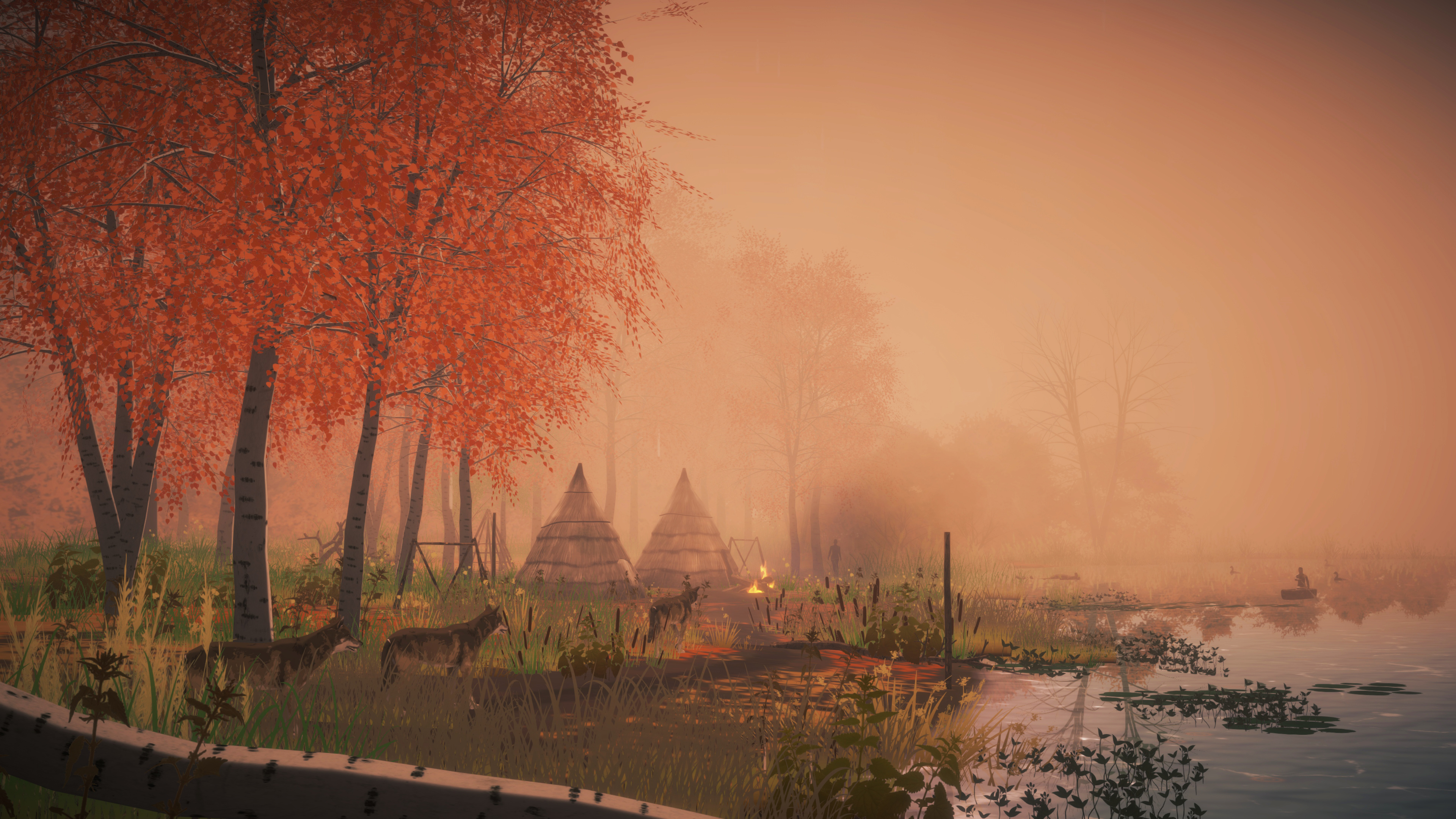
Star Carr: After the Ice is an interactive digital mural commissioned by York Museums Trust for the exhibition Star Carr: Life After The Ice.
Star Carr was a mesolithic settlement in North Yorkshire, England, established around 11,000 years ago: a few hundred years after the end of the last ice age. The people of Star Carr were hunter-gatherers, living by a huge freshwater lake, in a time of climate change as dramatic as that which we are seeing today. The settlement is an archaeological site of global significance and has yielded artefacts including the oldest bow found in Europe, the oldest dwelling in the UK and over 20 complete deer-antler headdresses.
Star Carr: After the Ice is an interactive mural created for a major exhibition at The Yorkshire Museum, York, UK. It was created to give viewers a glimpse into the lives of the people of Star Carr as they hunt, travel, worship, relax and play. The piece runs through day and night and seasonal cycles on an infinitely variable loop, with different weather, light conditions and activities occurring every day. A motion sensor enables the piece to respond to movement in front of it, with animals and birds startling and passing humans greeting the viewer. Some of these are rarer than others: deer are often seen moving in the woods, whereas wolves and bears may be seen only occasionally after many hours and multiple cycles.
The piece was designed to explore two concerns: making an archaeological reconstruction feel like a living place and using procedural generation and simple AI to give viewers a sense of both everyday events and special, rare moments.

This work was created as part of a collaboration with the following individuals.
Professor Nicky Milner, Department of Archaeology, University of York
Dr Jess Bates, Department of Archaeology, University of York
Dr Andrew Woods, York Museums Trust
Dr Adam Walker, York Museums Trust
Theodore Wilkins, York Museums Trust
Joe Rees-Jones, XR Stories
 Guy Schofield | Art & Research